Manure pellet mill for organic fertiliser
Manure costs you money to store and dispose of; organic fertiliser pellets are a product you can sell. We design and build the drying, grinding, pelleting and cooling line around your manure: chicken, cattle, compost or digestate.

Who pellets manure
Layer and broiler farms
Chicken manure and litter are the most common and most valuable raw material for organic fertiliser.
Cattle farms
The solid fraction from manure separation, on its own or in a blend.
Biogas plants
Separated and dried digestate as a fertiliser for sale.
Compost and substrate producers
Mature compost and spent mushroom substrate.
Nurseries and organic growers
Your own fertiliser of consistent composition, without the smell of fresh manure.
Fertiliser distributors
Your own production of pelleted organic fertiliser from manure supplied by nearby farms.
Why pellet manure
- Less space, easier transport: pelleting raises the bulk density of chicken manure from about 200 to about 780 kg/m³, so the same quantity takes up almost four times less space.
- Even spreading: pellets can be spread with an ordinary mineral fertiliser spreader, evenly and without lumps.
- Storage: dry pellets do not ferment and can wait for the spreading season.
- Less odour: dried, pelleted manure smells far less than fresh manure.
- A product to sell: pelleted manure is bought by vegetable growers, fruit growers, winegrowers and gardeners, mostly in spring.
- Nutrients: commercial pelleted poultry manure is declared at about 2–5% nitrogen, 2.5–4.3% P₂O₅ and 2–4.3% K₂O.
Which manures can be pelleted
| Raw material | How it behaves | Preparation |
|---|---|---|
| Chicken manure and litter | pellets well, rich in nitrogen | drying, grinding |
| Cattle manure (solid fraction) | the fibres help binding | separation, drying, grinding |
| Sheep, horse and rabbit manure | similar to cattle manure, often with bedding | drying, grinding |
| Compost | pellets well when mature and screened | screening, drying |
| Biogas digestate | pelleted after separation and drying | separation, drying |
| Spent mushroom substrate | fibrous, pelleted after drying | drying, grinding |
| Pig manure | low in fibre, hard to pellet on its own | blending with straw or sawdust, drying |
NPK nutrients, humic acids and other additives can be added to the mix. For blends, we assess capacity and quality for your raw material.
Moisture limits for manure at the pellet mill
Moisture is the most important parameter. Manure that is too dry (below about 10%) is dusty and binds poorly, while manure that is too wet (above about 50%) gives soft pellets that fall apart.
| Raw material | Moisture at the die | Note |
|---|---|---|
| Chicken manure and litter | about 15–25% | pellet strength falls as moisture rises; finished pellets are dried further to 8–10% |
| Cattle manure compost | about 21% (8 mm pellets) to 27% (6 mm pellets) | pelleting reduces moisture by more than 40% |
| Pig manure compost with sawdust | about 15–20% | particles up to 3 mm give pellet durability above 98% |
| Dried digestate | about 7–8% | pelleted after separation and drying |
Values come from university research and equipment manufacturers. We adjust drying and the die to your manure during commissioning.
From manure to bagged pellets
-
1
Stabilisation
Where needed, fresh manure is composted or fermented to stabilise it and reduce odour.
-
2
Drying
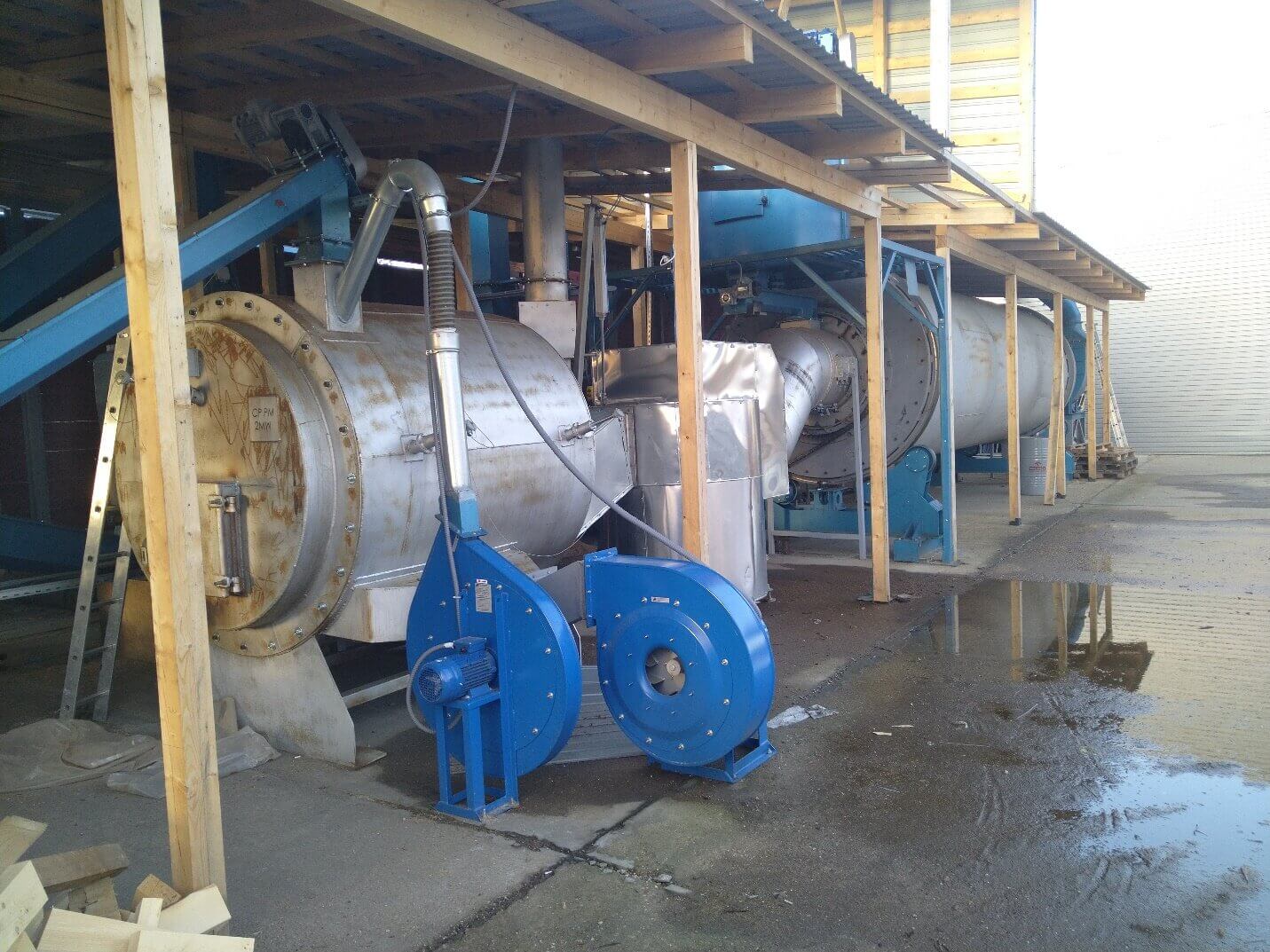
A dryer brings the moisture down to a level suitable for pelleting.
⚙️ Rotary dryer → -
3
Grinding
A hammer mill breaks up lumps, straw and bedding.
⚙️ AMC hammer mill → -
4
Hygienisation
For fertiliser that will be sold, the manure is heated to at least 70 °C for at least 60 minutes in a separate step before pelleting.
-
5
Mixing with additives
NPK, humic acids or a binder (molasses, starch, lignosulphonates) are added as needed.
⚙️ Mixers → -
6
Pelleting
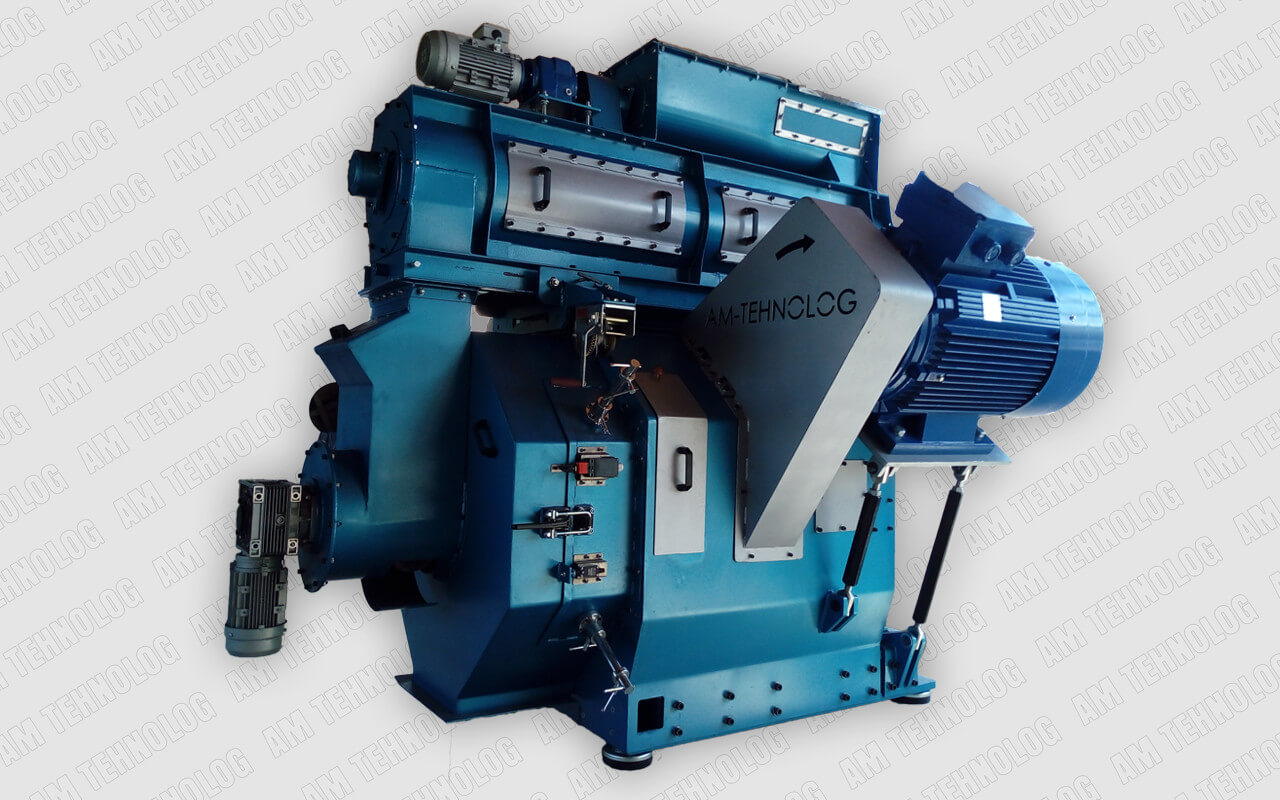
A pellet mill with a fertiliser die forms pellets of the set diameter.
⚙️ AMP pellet mills → -
7
Cooling
The pellets are cooled and dried before storage.
⚙️ Counterflow cooler → -
8
Screening
Fines are returned to the process.
⚙️ Vibro sieve → -
9
Bagging
Small bags for gardeners and retail, or big bags for agriculture.
What you need to sell pelleted manure
- Hygienisation: in the EU, processed manure placed on the market must come from an approved plant, be heated to at least 70 °C for at least 60 minutes and meet the limits for Salmonella and E. coli (Regulation (EC) No 1069/2009 and Regulation (EU) No 142/2011). A pellet mill does not provide this treatment on its own, so a line producing fertiliser for sale includes a separate hygienisation step.
- CE-marked fertilisers: organic fertilisers sold with the CE mark fall under Regulation (EU) 2019/1009, which sets requirements for organic carbon, nutrients and microbiological limits.
- National registration: rules for registering fertilisers differ from country to country, so check with your national authority whether your pelleted product needs to be registered before you sell it.
This is an overview, not legal advice. When we design a line for fertiliser sales, we include the hygienisation equipment; check the requirements for your plant with the competent authorities in your country.
Manure pelleting technology
Questions about pelleting manure
Which types of manure can be pelleted?
Chicken manure and litter, the solid fraction of cattle manure, sheep, horse and rabbit manure, compost, digestate and spent mushroom substrate. Pig manure is low in fibre, so it is blended with straw or sawdust.
How much moisture can the manure have?
At the die, usually 15–27%, depending on the type of manure and the pellet diameter. Below about 10% the material is dusty, and above about 50% the pellets are soft and fall apart.
Is composting necessary?
Not always, but stabilised, composted manure gives a more consistent product with less odour. To sell processed manure as fertiliser in the EU, hygienisation at a minimum of 70 °C for 60 minutes is mandatory.
What approvals do I need to sell it?
In the EU, a plant that processes manure for the market must be approved under the animal by-products rules (Regulation (EC) No 1069/2009), and the product must meet the treatment, Salmonella and E. coli requirements of Regulation (EU) No 142/2011. CE-marked organic fertilisers must also comply with Regulation (EU) 2019/1009, while national registration rules differ, so check with your national authority. This is an overview, not legal advice; see the regulations section above for more detail.
Can I add NPK?
Yes. Mineral nutrients, humic acids and other additives are mixed in before pelleting, giving an organo-mineral fertiliser of consistent composition.
Can the pellets be spread with an ordinary spreader?
Yes. Pellets of uniform size can be spread with a mineral fertiliser spreader, or by hand in gardens.
What about the smell?
Drying and pelleting reduce odour considerably. For the dryer and the line, we design dust extraction and exhaust air handling to suit your site.
How big a farm do I need for a line?
That depends on the quantity and moisture of the manure, because it is the dry matter that gets pelleted. For example, a farm with 40 horses in Slovakia makes about 300 kg of pellets a day from about 600 kg of manure. Tell us how many tonnes of manure you have per day or per year and how wet it is, and we will size the line for your farm.
Digestate: fertiliser or fuel?
Dried digestate is most often pelleted as fertiliser. It can also be used as fuel: in one study, digestate pellets had 4.4–5.2% ash and about 17 MJ/kg, which meets the ISO 17225-6 agri-pellet standard, but they need boilers designed for agri-pellets.
How long do delivery and installation take?
We deliver machines in 4–8 weeks and complete lines in 12–20 weeks from order confirmation. Installation, commissioning and training take 3–4 weeks.
A fertiliser line built around your manure
Tell us what manure you have, how much of it and what you want to do with the pellets. Based on that, we design a line for your farm alone, with hygienisation if you sell the fertiliser.
In your enquiry, tell us:
- the type of manure and whether it contains bedding
- the quantity: tonnes per day, week or year
- how wet it is, if you know
- whether you will sell the pellets or use them on your own land
We reply within 24 hours.