Our smallest pellet mill, animal feed
On its very first run, the model for smaller farms produced good-quality pelleted feed.
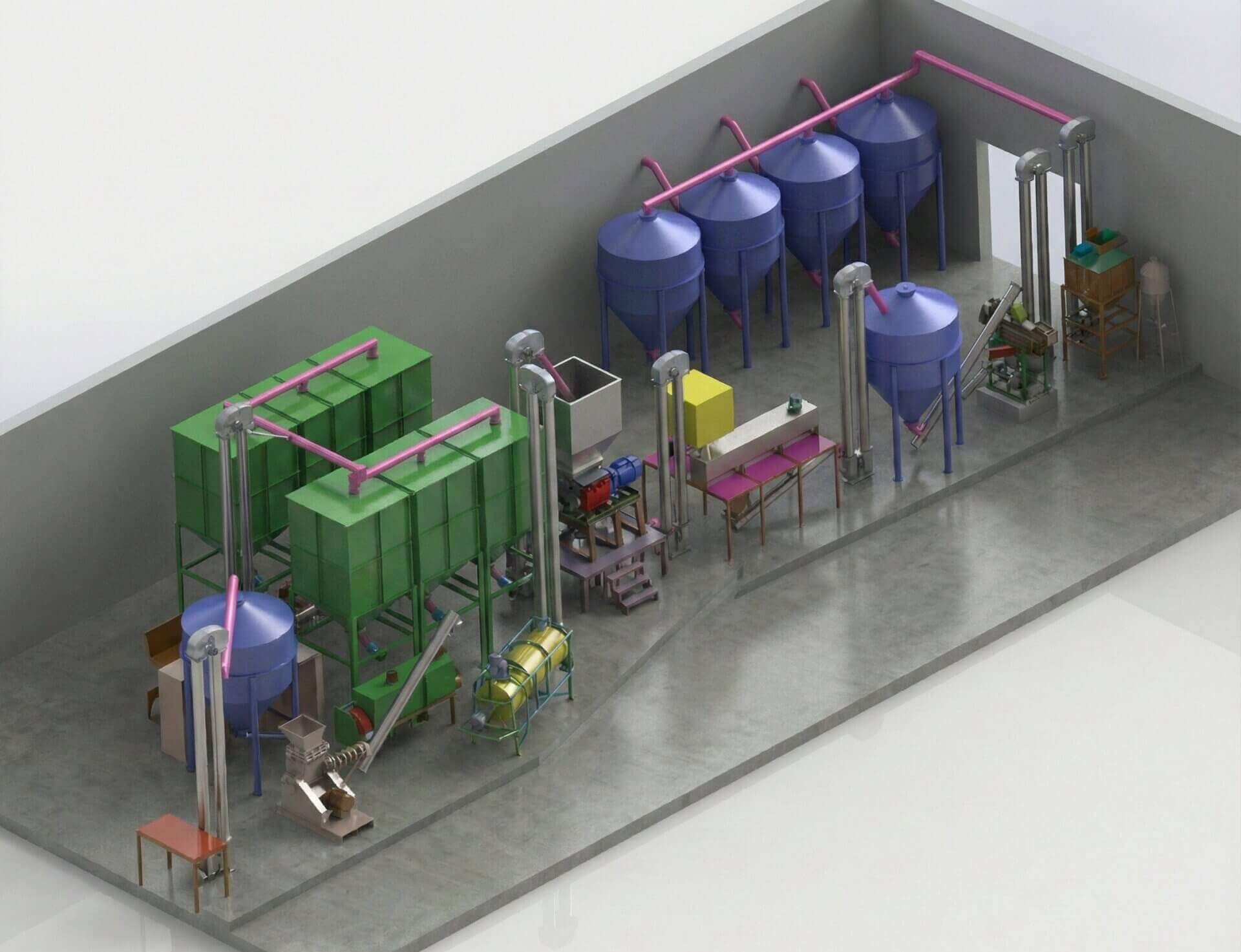
Project news →We design and build animal feed pellet mills and complete feed lines around your farm or feed mill. You tell us which animals you feed, from which raw materials and how much you need, and we adapt the pellet mill, the dies and the equipment around it. Capacity ranges from 1 to 18 tonnes per hour.

Pelleted compound feed for sale, with several formulations a day and quick die changes.
Your own feed for piglets, finishers and sows, without the cost of buying in pellets.
Pellets and crumbles for broilers, layers and turkeys.
Concentrate for dairy cows, beef cattle and calves.
Pellets from concentrate and lucerne (alfalfa), with less waste than mash.
Sinking feed for carp and other species. Floating feed is made on an extruder.
Extruded fish feed →Pellet diameter is set by the species and age of the animal. Each diameter needs its own die, and a die change takes 15–30 minutes.
| Species | Category | Typical form and diameter |
|---|---|---|
| Pigs | piglets | crumbles or 3–4 mm pellets |
| Pigs | finishers | pellets of about 4–5 mm |
| Poultry | broilers up to day 10 | crumbles |
| Poultry | broilers, days 11–28 | 2–3 mm pellets |
| Poultry | broilers, finisher phase | 3–4 mm pellets |
| Poultry | layers | mostly mash; 1–3 mm crumbles for the starter phase |
| Cattle | dairy cows and beef cattle | 6–8 mm pellets |
| Cattle | calves | 3–6 mm pellets |
| Goats | kids (creep feed) | 4–5 mm pellets |
| Rabbits | all categories | 2.5–4 mm pellets |
| Fish | sinking feed, by fish size | from 1–1.5 mm crumbles to 4 mm pellets; floating feed is made on an extruder |
Values are based on recommendations from breeding companies (Aviagen, Hy-Line), universities and the FAO. The exact diameter and form are decided by your nutritionist and the farm, and we choose the die to match the formulation.
| Group | Raw materials | Note |
|---|---|---|
| Energy | maize, wheat, barley, triticale, oats, bran | ground before mixing; particle size affects pellet hardness |
| Protein | soybean and sunflower meal, oilseed cakes, extruded full-fat soya, fish meal | full-fat soya is produced on a soybean extruder |
| Fibre | lucerne, hay, straw, sugar beet pulp | mainly for ruminants, rabbits and horses |
| Liquids and additives | molasses, oil and fat, premixes, minerals, vitamins, amino acids | higher fat levels are added after pelleting, by coating |
The raw material passes a magnet and a screen, so that metal and coarse impurities do not damage the mill or the die.
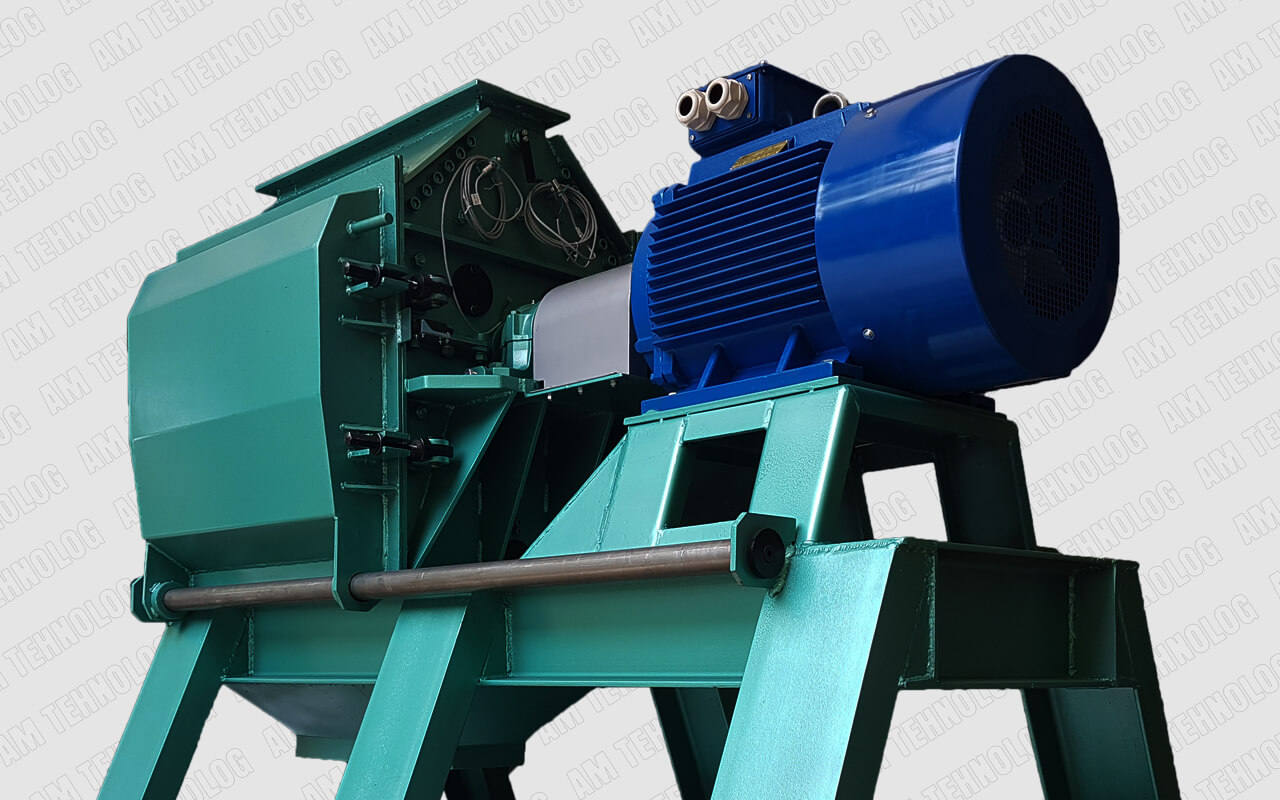
A hammer mill grinds the grain to the particle size the formulation calls for. Finer grinding gives a harder pellet.
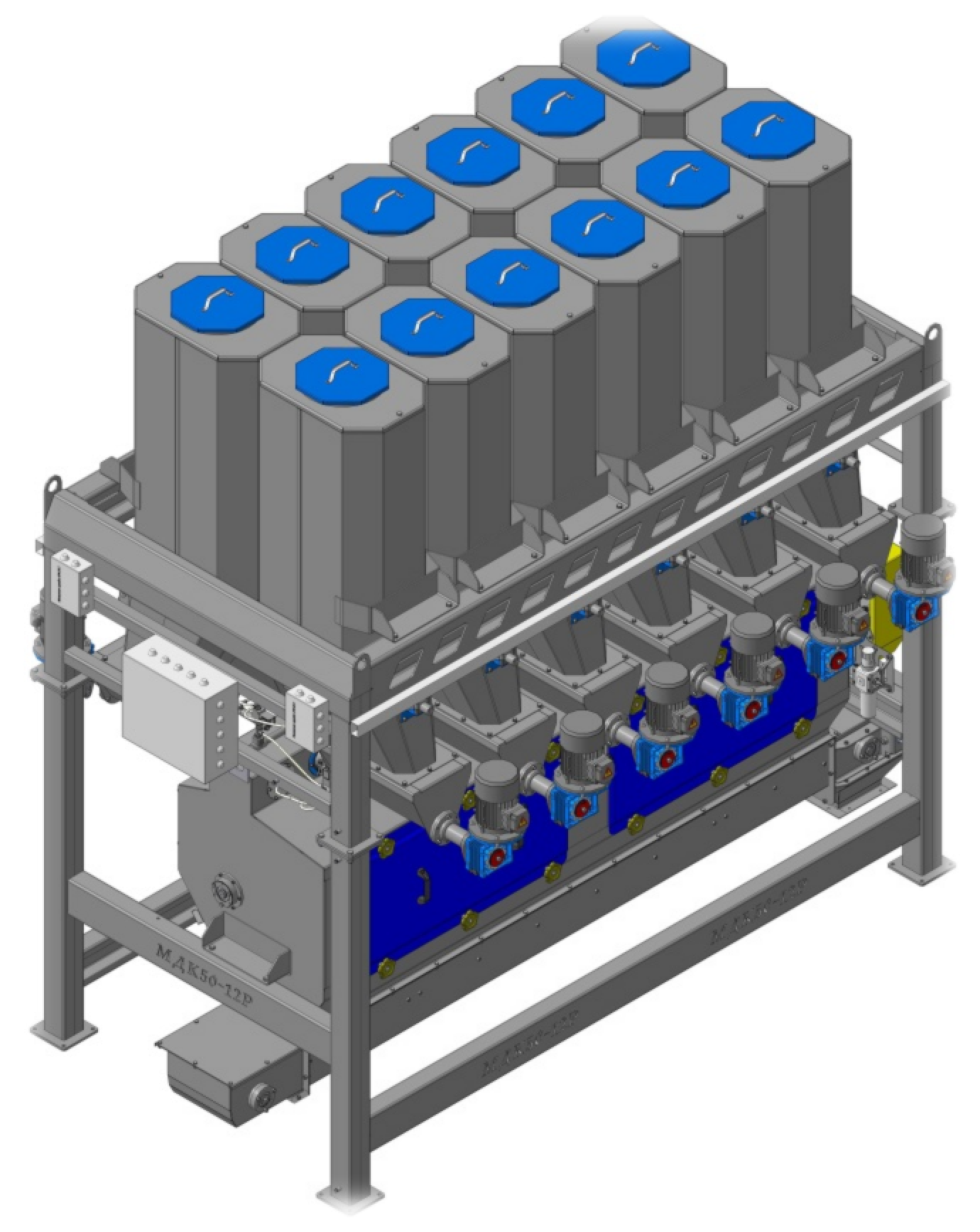
⚙️ AMC hammer mill →The ingredients are weighed to the formulation and mixed with premixes and liquids.
⚙️ Mixers →In the mixer-conditioner, steam heats and moistens the mash, so it presses more easily and gives a firmer pellet.
Rollers press the mash through the ring die, and knives cut the pellets to the set length.
⚙️ AMP pellet mills →Hot, moist pellets are cooled and dried in a counterflow cooler, so they do not go mouldy in storage.
⚙️ Counterflow cooler →A screen removes the fines, which go back to the pellet mill.
⚙️ Vibro sieve →The pellets go to a silo for the farm or into bags for sale.
| Model | Capacity on animal feed | Pellet mill power | Mixer-conditioner | Suitable for |
|---|---|---|---|---|
| Smaller model | up to 200 kg/h | on request | on request | smaller farms |
| AMP-304 | 1–2 t/h | 37–55 kW | 3 kW | farms and smaller feed mills |
| AMP-420 | 3–5 t/h | 90–110 kW | 5.5 kW | large farms and regional feed mills |
| AMP-530 | 7–9 t/h | 110–150 kW | 7.5 kW | industrial feed mills |
| AMP-650 | 15–18 t/h | 180–220 kW | 11 kW | large compound feed plants |
Capacity depends on the formulation, pellet diameter and conditioning: higher-fibre feeds and smaller pellets reduce capacity. For full technical data on each model, see AMP pellet mills.
| Parameter | Typical value | Why it matters |
|---|---|---|
| Particle size after grinding | 500–800 µm (mill screen about 3–5 mm) | finer particles bind better and give a harder pellet |
| Conditioning temperature | about 80–90 °C for cereal-based feeds; 60–75 °C with molasses | steam softens the starch, so the pellet binds better |
| Mash moisture at the die | 16–18%, of which 4–5% comes from steam | above 18% the die can choke |
| Steam consumption | about 40–60 kg per tonne of feed | determines the size of the boiler |
| Die thickness | about 40–50 mm for a 4 mm hole | a thicker die gives a harder pellet but a lower capacity |
| Fat added in the mixer | up to about 2% | more fat weakens the pellet; the rest is added by coating after cooling |
| Pelleting energy | poultry 10–12, pigs 15–17, ruminants 20–24 kWh/t | fibrous ruminant feeds need more energy |
Pellet quality depends most on the formulation (about 40%), followed by grinding and conditioning (about 20% each), the die (15%) and cooling (5%). Pellet durability (PDI) is measured with a standard tumbling test (ASAE S269.5). We fine-tune the parameters during commissioning.
On its very first run, the model for smaller farms produced good-quality pelleted feed.
Project news →A galvanised sheet steel support structure for the chain conveyors of a feed mill.
Project news →A system for cooling and conveying extruded soya, the raw material for the protein part of the feed.
Project news →Start from your daily feed consumption. A finishing pig eats on average about 2.15 kg of feed a day, so a 1,000-head finishing unit uses about 2.2 t a day. An AMP-304 makes that in one to two hours, so even the smallest industrial model is enough for a farm of that size. For a feed mill selling feed, work from planned sales and the number of shifts.
For good-quality, hard pellets from compound feed, yes. Cereal-rich feeds are conditioned at 80 °C or more, using about 40–60 kg of steam per tonne of feed. Steam heats and moistens the mash, so the starch binds better and the die wears less. Some feeds can be pelleted without steam, but with a lower capacity and softer pellets.
For chicks up to day 10, crumbles, then 2–3 mm and 3–4 mm in the finisher phase. For piglets, crumbles or 3–4 mm; for finishing pigs about 4–5 mm; for rabbits 2.5–4 mm; and for cattle 6–8 mm. The table above covers every category.
The formulation, grinding fineness, conditioning and the die have the biggest effect. Finer grinding, enough steam and a die of the right thickness give a harder pellet. Add fat mainly after pelleting, and always cool the pellets before storage.
No more than about 2% added fat in the mixer, because more fat weakens the pellet: in one trial, raising soya oil from 1.5% to 3% cut pellet durability from 69% to 57%. The rest is added by coating the cooled pellets.
Yes. Pure lucerne is pelleted at about 9–11% moisture, with conditioning at 76–92 °C and a thick die. Stems without leaves make a weak pellet, and capacity is lower than on compound feed. Tell us what lucerne you have and how much, and we will configure the machine for it.
According to Iowa State University, pelleted feed improves growth and feed conversion in pigs by 4–8%. The pellets must be hard: in one trial, finishing pigs fed pellets without fines had a feed conversion ratio of 2.65, against 2.78 on mash.
A pellet mill uses about 10–12 kWh per tonne for poultry feed, 15–17 kWh for pig feed and 20–24 kWh for ruminant feed. More fat in the mash reduces consumption.
A pellet mill makes sinking feed, which is enough for carp and catfish in ponds. Floating feed and high-fat feed need an extruder.
Die life depends on the formulation, how abrasive the raw material is and maintenance. On animal feed a die lasts longer than on wood or raw materials containing sand. We keep spare dies and rollers in stock in Serbia and dispatch them within 24–48 hours.
We deliver the pellet mill in 4–8 weeks and a complete line in 12–20 weeks from order confirmation. Installation, commissioning and training take 3–4 weeks.
The price depends on the model, the number of dies, the conditioner and the equipment around the pellet mill. Tell us which animals you feed, from what and how much you need, and we will design a line to measure and send you a quotation within 24 hours.
Tell us which animals you feed, from which raw materials and how much you need. Based on that, we design a pellet mill or a complete line for your farm or feed mill alone.
In your enquiry, tell us:
We reply within 24 hours.