Dren Eko, Čelarevo, Serbia
An AMP-530 pellet mill commissioned to turn wood waste into wood pellets.
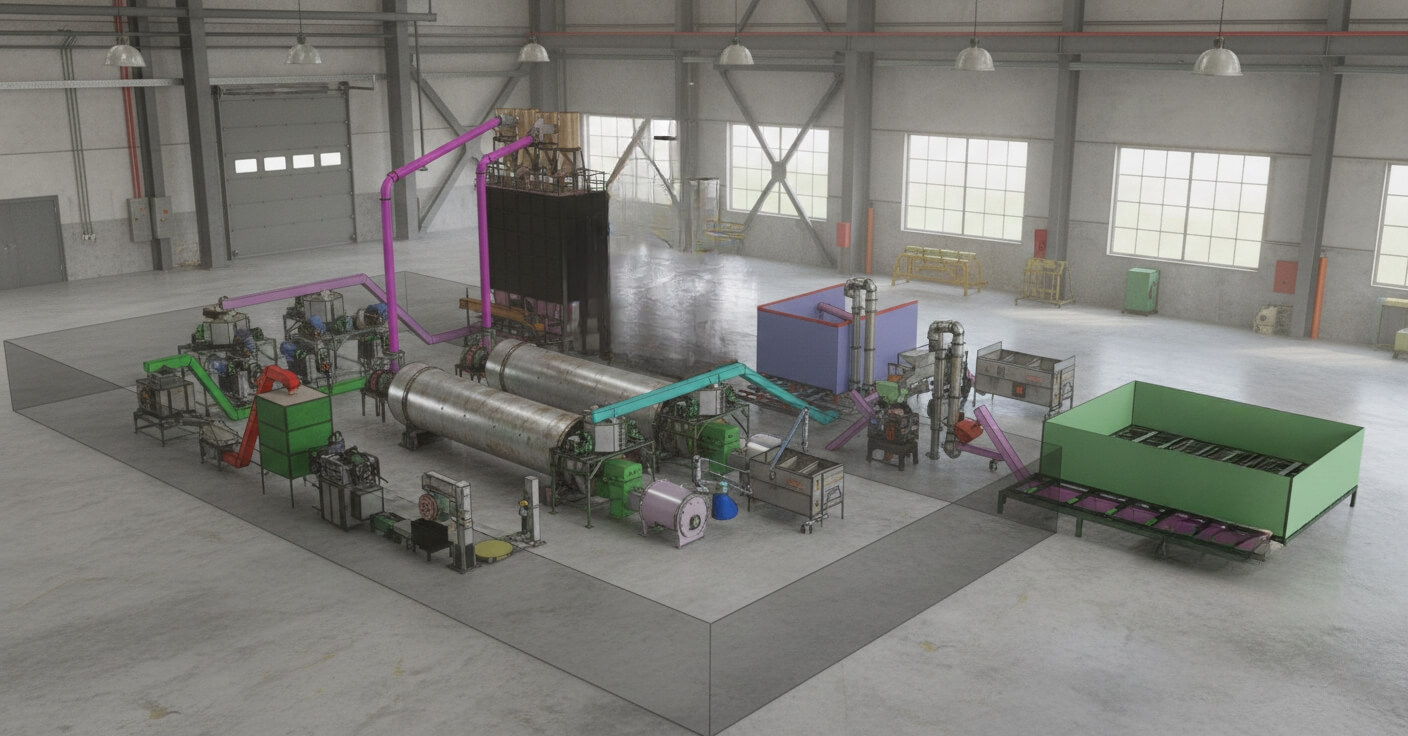
Project news →We design and build wood and agri-pellet lines around your raw material: sawdust, shavings, wood chips, straw, maize stover or sunflower husks. Based on the type, moisture and quantity of the material, we select the crusher, dryer, mill and biomass pellet mill, for 0.5 to 4 tonnes of wood pellets per hour.

Sawdust, offcuts and bark become a product to sell instead of waste.
Dry shavings and sawdust from untreated wood, often with no need for a dryer.
Wood chips and forest residues, with crushing and drying.
Straw, maize stover and cobs as agri-pellets for your own boiler or for sale.
Sunflower husks as fuel for your own boiler house or for sale.
A new wood pellet line, from design to commissioning.
| Raw material | Pellets for | Ash and calorific value | Preparation notes |
|---|---|---|---|
| Dry sawdust and shavings | heating; class A1 or A2 if the wood is untreated | ash up to 0.7% (A1), ≥ 16.5 MJ/kg | below about 15% moisture no dryer is needed, only grinding |
| Wet sawdust, wood chips, offcuts | heating | as for wood | crusher and dryer before grinding |
| Bark | heating, lower class | more ash | pellets usually class B or for industrial boilers |
| Untreated wooden pallets | heating | as for wood | remove nails and metal; pallets marked MB (methyl bromide) are not suitable |
| Wheat, barley and rapeseed straw | agri-pellets, animal bedding | ash about 4%, 17.5 MJ/kg dry matter | bale shredder and mill; 14–16% moisture at the pellet mill |
| Maize stover | agri-pellets | ash 4.8–7.3%, about 17 MJ/kg | soil and sand wear the die faster |
| Maize cobs | agri-pellets | ash 1–2.7%, about 16.3 MJ/kg | grinding |
| Sunflower husks | boiler fuel | ash 2.4–3.6%, about 19 MJ/kg | high silica content wears the die; needs a reinforced design |
| Miscanthus | fuel | ash 2.4–2.6%, 15–16 MJ/kg | drying and fine grinding |
| Orchard and vineyard prunings | heating | ash about 3%, 15.6–16.4 MJ/kg | chipping and grinding |
Demolition wood, chipboard, MDF and lacquered wood are not permitted in certified wood pellets. For these, ask us for an assessment before we quote.
The pellet class depends mainly on the raw material: clean sawdust without bark gives A1, while pellets containing bark and residues are usually A2 or B.
| Property | A1 | A2 | B |
|---|---|---|---|
| Diameter | 6 or 8 mm (±1) | 6 or 8 mm (±1) | 6 or 8 mm (±1) |
| Moisture | ≤ 10% | ≤ 10% | ≤ 10% |
| Ash | ≤ 0.7% | ≤ 1.2% | ≤ 2.0% |
| Mechanical durability | ≥ 98.0% | ≥ 97.5% | ≥ 96.5% |
| Fines | ≤ 1% | ≤ 1% | ≤ 1% |
| Length | 3.15–40 mm | 3.15–40 mm | 3.15–40 mm |
| Bulk density | 600–750 kg/m³ | 600–750 kg/m³ | 600–750 kg/m³ |
| Net calorific value | ≥ 16.5 MJ/kg | ≥ 16.5 MJ/kg | ≥ 16.5 MJ/kg |
Source: ISO 17225-2 (the 2014 edition requires 97.5% durability for A1, while the current DIN EN ISO 17225-2 and ENplus require 98.0%). For class B, ENplus requires 97.5% and also limits nitrogen, chlorine and the temperature at loading. Certification also requires production control.
Pellets from straw, husks and other non-woody raw materials contain more ash and do not fall into the wood pellet classes. A separate standard applies to them.
| Property | Class A | Class B |
|---|---|---|
| Moisture | ≤ 12% | ≤ 15% |
| Ash | ≤ 6% | ≤ 10% |
| Mechanical durability | ≥ 97.5% | ≥ 96% |
| Net calorific value | ≥ 14.5 MJ/kg | ≥ 14.5 MJ/kg |
| Chlorine | ≤ 0.1% | ≤ 0.3% |
Source: ISO 17225-6, 2014 edition. In testing, pellets from pure wheat straw had 4.2% ash and 96.4% durability, and sunflower husk pellets 96.3% durability.
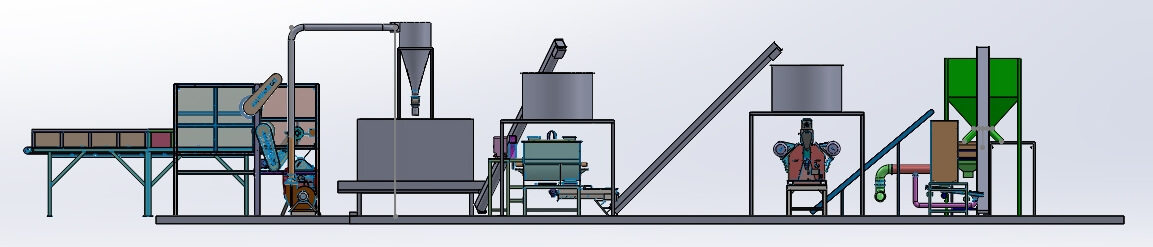
Large pieces, offcuts and wood chips are reduced in size on a crusher.
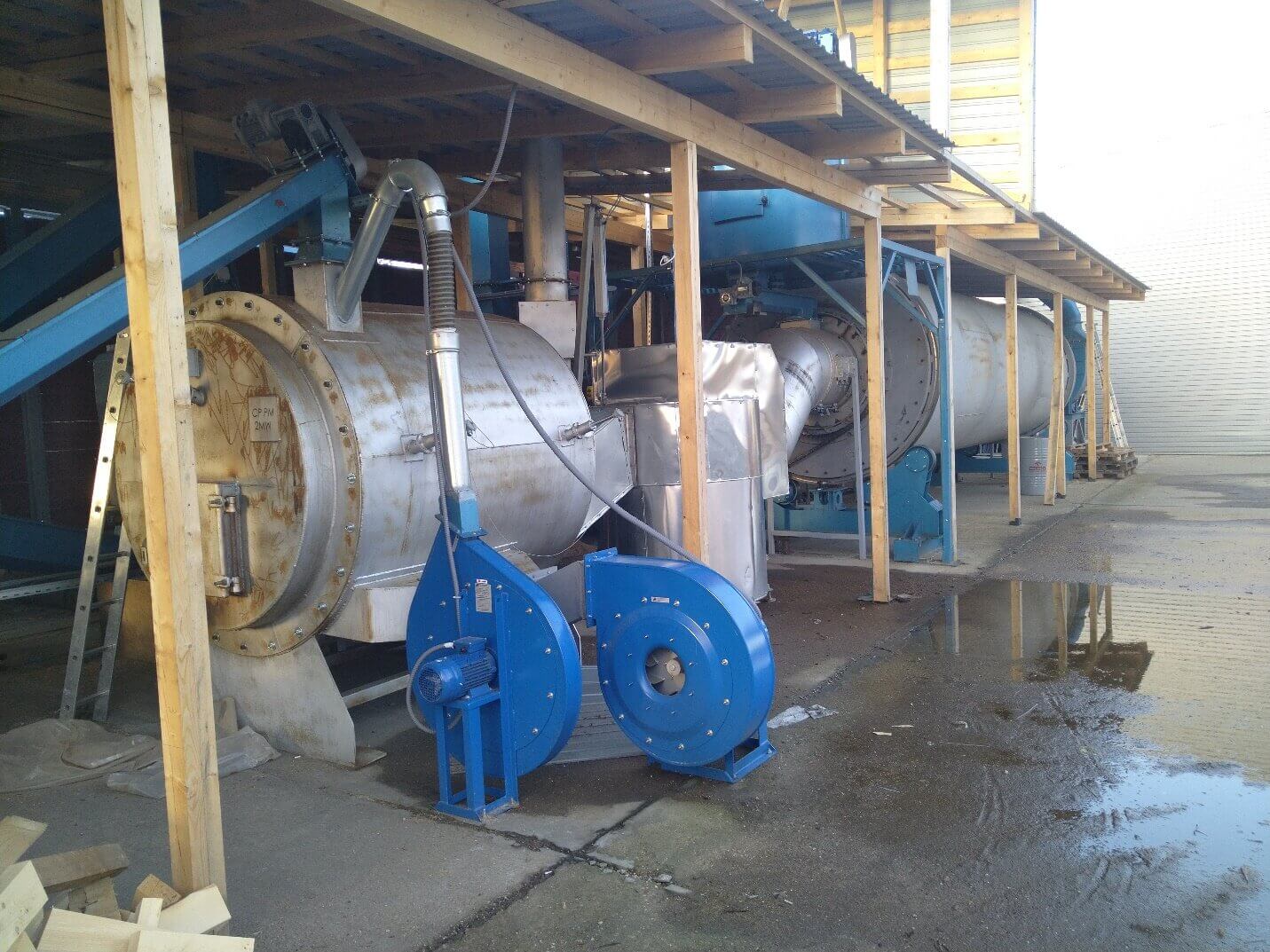
⚙️ CM-150 crusher →Wet raw material is dried to 10–15% moisture. Dry sawdust from joinery shops skips this step.
⚙️ Rotary dryer →A hammer mill grinds the material through a screen of about 4 mm to an even particle size, smaller than the pellet diameter.
⚙️ AMC hammer mill →A feeder fills the pellet mill evenly, and moisture is adjusted with water or steam as needed.
Under pressure and heat in the die, the lignin in the wood binds the particles together, so a binder is usually not needed.
⚙️ AMP pellet mills →The hot pellets are cooled and hardened in a counterflow cooler. They leave the cooler at about 6% moisture and settle at 8–10% in storage.
⚙️ Counterflow cooler →Fines are separated and returned to the process.
⚙️ Vibro sieve →The pellets are packed in 15 kg bags on pallets or in big bags.
| Model | Capacity on wood | Pellet mill power | Suitable for |
|---|---|---|---|
| AMP-304 | 0.5–0.6 t/h | 37–55 kW | joinery shops, smaller sawmills, straw agri-pellets |
| AMP-420 | on request | 90–110 kW | medium-sized sawmills |
| AMP-530 | about 1.5 t/h | 110–150 kW | sawmills and pellet producers |
| AMP-650 | 2–4 t/h | 180–220 kW | industrial pellet production |
These figures come from lines we have delivered. Capacity depends on the wood species, moisture and particle size: hardwood, straw and husks give less than soft sawdust. Pelleting wood takes about 50–70 kWh per tonne, several times more than animal feed, so the same pellet mill produces less on wood. For higher capacities, several pellet mills are installed in one line.
An AMP-530 pellet mill commissioned to turn wood waste into wood pellets.
Project news →A beech pelleting plant with dosing and conveying: up to 4 tonnes of pellets in an eight-hour shift.
Project news →
A line with an AMP-304 pellet mill, hammer mill, conveyors and bagging.
A straw crusher with conveyors and a dedusting filter for a straw pelleting line.
Project news →If your raw material is wetter than about 15%, yes. Fresh sawdust from a sawmill holds far more moisture and has to be dried to 10–15% before grinding. Dry shavings from a joinery shop usually go straight to the mill.
The class depends mainly on the raw material. Clean sawdust without bark can reach A1; with bark and residues, the pellets are usually A2 or B. Straw, husks and maize stover contain more ash and count as agri-pellets, not wood pellets.
Yes, but with a different die and different preparation. Straw needs a bale shredder and fine grinding, and sunflower husks are abrasive and wear the die faster.
For wood, usually not, because the lignin in the wood binds the pellet under pressure and heat. For straw and some agricultural raw materials, a small amount of binder is sometimes added. ENplus allows a maximum of 2% additives. Anti-slagging additives such as kaolin reduce particulate emissions but wear the die and rollers faster.
That depends on the raw material: they last longer on clean softwood sawdust and less on bark, straw containing soil, and husks. We dispatch spare dies and rollers from our warehouse in Serbia within 24–48 hours, and a die change takes 15–30 minutes.
The pellet mill alone uses about 50–70 kWh per tonne on wood, and grinding and pelleting together about 75–80 kWh per tonne. Drying wet raw material is a separate cost, so the dryer is often fired with bark or waste from the same production.
That depends on the price of the raw material and of pellets. According to an analysis by the Bioenergy Association of Ukraine (UABIO), a sunflower husk pellet plant pays for itself in 2–5 years, and a straw pellet plant in 8–12 years. The fastest payback comes from a line for a raw material you already have and that is already dry.
A 500 kg/h line produces up to 4 tonnes of pellets in an eight-hour shift, depending on the moisture and quality of the raw material. That is what the beech line in Pale produces.
Dry, indoors and protected from moisture, because pellets that absorb water swell and fall apart. In enclosed stores and silos, pellets give off carbon monoxide, most of all in the first week after filling, so the space must be ventilated and fitted with a CO detector before anyone goes in.
We deliver a complete line in 12–20 weeks from order confirmation, and installation, commissioning and training take 3–4 weeks.
The price depends on capacity and on whether a dryer and crusher are needed. Tell us what raw material you have, how wet it is and how many pellets you need, and we will design a line to measure and send you a quotation within 24 hours.
Tell us what raw material you have, how much of it and what you want from the pellets. Based on that, we design a line for your raw material alone, from intake to bagging.
In your enquiry, tell us:
We reply within 24 hours.